Showing posts with label cryptocurrency. Show all posts

Friday, 19 February 2021

How Blockchain can make its way in various businesses?


JD Coin Review


Blockchain technology that originated from a mathematics branch called cryptography can seem difficult, and it can certainly be for any ordinary individual, but its central idea is pretty basic indeed. The technology first gained recognition as a cryptocurrency network such as Bitcoin. Traditional tracking systems are unable to scale with increasing demand for fast distribution services, so the blockchain future is close and is now expanding through a wave of industries.

To make faster paced decisions, companies need modified, secure and authentic data nowadays. In any sized company, it plays a larger role as it offers a scalable, immediate solution for every order authentication. Blockchain technology is basically a virtual ledger capable of tracking and verifying a high volume of digital transactions, allowing business processes to be more productive and cost-effective. New platforms created by Blockchain allow simple document coordination on a shared distributed ledger, making physical paperwork largely unnecessary.

JD Coin Review

Approvals and customs clearance can become faster with the use of smart contracts, reducing processing times for goods at customs checkpoints, which means entrepreneurs can run their companies more transparently. As the whole network leads to data authentication, Blockchain ensures trustworthy data across the transport and logistics ecosystem. For improved supply chain management, more open contracts, quicker payments and faster background checks, Blockchain can be a game-changer. Using the Internet of Things (IoT) and AI (Artificial Intelligence), Blockchain allows better freight tracking to improve performance, which can be especially useful for capacity monitoring. It also conducts efficient fleet or vehicle performance history monitoring for simpler & accurate on boarding of the carrier.

Intelligent contracts with efficient cost control and removal of intermediaries improve liquidity in the supply chain. Blockchain can evolve over time and, because of their distributed existence, are theoretically self-sustaining. Organizations across the business spectrum are coming to the realization that they can use blockchain technology to streamline their activities and provide their customers with better services. Together with intelligent contracts and digital currencies, the blockchain can make trade and government processes safer, quicker, more efficient and more scalable. And as more and more small players, backed by digital technology, enter the market, the economy will continue its journey towards decentralization.

Thursday, 7 January 2021

Brands that accept digital currency/payments in crypto:

As time passes, the general public is becoming more aware and well known about the digital currency or cryptocurrency. Blockchain technology is adopted by growing numbers of businesses and huge brands as a means of payment for products and services every day following the demands of their consumers, bringing cryptocurrency mass adoption closer to existence. It is now just a matter of time before all traders worldwide can accept cryptocurrencies.


JD Coin Review

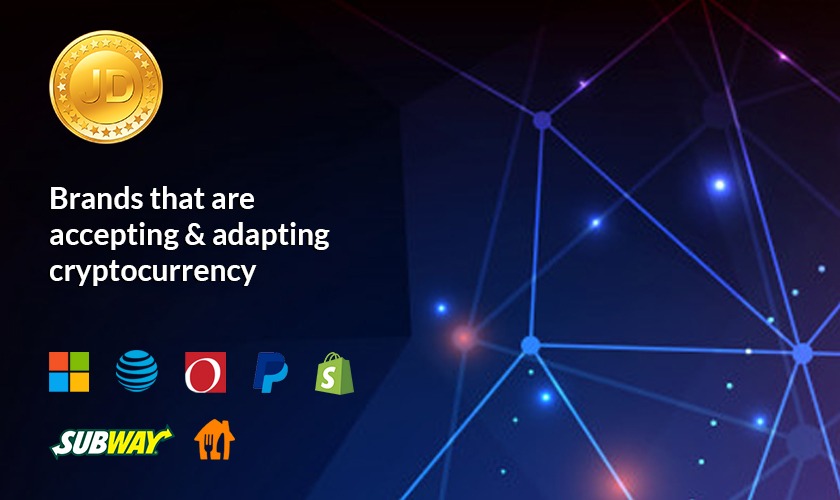
Here are some of the companies that accepted cryptocurrency as their payment solutions and marking a significant change in the financial ecosystem:

Microsoft

Back in December 2014, one of the world’s most famous IT companies opened the doors to this bold innovation. It is real, however, that due to high transaction fees, the company made a short pause in January 2018, but in the recent scenario, crypto payments can be made for some of its items only as in the Xbox store

AT&T

press release declaring the news was released in May 2019 by this world’s largest telephone communications company. The combination has made the new installment accessible to every one of its clients with the assistance of the administration BitPay and now authoritatively acknowledges bitcoins.

Boatsters Black

This worldwide yacht contract organization began offering a crypto installment alternative to its extravagant clients in June 2018 which turned out to be a successful initiative for the company. After the new installment choice was executed, the number of sanction demands expanded as the newly emerged crypto-millionaires were finally offered an alternative to utilize their advanced digital reserve funds in real life.

Overstock

One of the greatest US retailers, Overstock has consistently been a sharp spectator of digital innovations. It was one of the first global brands to begin accepting crypto payments back in 2014 as an official means of payment and, interestingly, it still offers its customers different types of cryptocurrencies as an option.

Subway
This is another major company that understands the future scope of digital currency and is now accepting cryptocurrency. They also allowed the trading of crypto assets such as Bitcoin for food products.

Takeaway.com
In summer 2017, this European fast-food delivery firm, which operates across 11 nations, including Germany and the Netherlands, entered the crypto frenzy. As their customers can order their favorite meals through a single gateway and pay with cryptocurrency, the company’s website acts as a one-stop-shop for numerous restaurants.

PayPal
PayPal has joined the encrypted money business, announcing that its customers would have the choice of using their PayPal accounts to buy and sell Bitcoin and other virtual monetary assets which then can easily be used to buy items from the 26 million PayPal-recognized merchants.

Shopify
Shopify is one of the well-known businesses with a major change to accept cryptocurrencies as early as 2013, providing consumers with ease of payment to set up their own online shop.

Cryptocurrencies are now globally recognized there is no doubt that it serves some meaningful purposes and is a useful form of payment. Crypto Assets will serve the need for a direct payment commodity that is not intermediated and is proving to withstand mass interest around the world. The larger companies see the potential for cryptocurrencies to prove to be a more convenient means of payment and the big companies will begin adding them to their balance sheets in the near future.

Tuesday, 13 October 2020

Is Cryptocurrency Set to Explode After 2020?

JD Coin Review
 

Cryptocurrency isn’t a new concept, but it’s only now that more people are seriously considering it as a viable alternative to fiat currency. In fact, TechCrunch points out that cryptocurrency has even more uses beyond being a form of electronic cash due to the technology underneath it — blockchain. This technology can improve frictionless transactions of all kinds, as well as increase financial transparency and security. Yet despite these benefits there still continues to be tight regulations over cryptocurrency across the globe.

This stance may now change due to the pandemic, with many physical processes shifting to digital and contactless. And even beyond 2020, it’s likely that cryptocurrency will explode further due to these three key trends:

Banks starting to hold crypto

Since time immemorial, banks have served as a custodian for valuable objects of consumers. But now, Fortune reports that they will be able to hold cryptocurrencies too, all thanks to a new policy by a federal banking regulator. In a letter published by the Office of the Comptroller of the Currency (OCC), it was noted that national banks and savings associations are now permitted to engage in custody service for their respective clients.

This is a huge leap, considering how major banks have long avoided crypto. The policy now enables them to open crypto operations, which have usually been under the purview of companies like Coinbase and BitGo. Moreover, with banks having custody over cryptocurrencies, it allows for a lucrative line of business. This is because the market cap of popular cryptocurrencies amounts to billions, with the custodians usually charging fees of 0.25% for safeguarding. With more banks taking advantage of this it’s likely that more people will be inclined to invest in crypto. Knowing that their trusted financial institutions will hold their digital coins for them will give them confidence in the stability of the digital currencies.

Continued and rapid rise in the popularity of digital coins

It’s not the ideal scenario, but it’s evident that the pandemic has prompted the resurgence of Bitcoin and a slew of other digital currencies. Bitcoin has more than doubled since March, and has even outpaced gains in equities and precious metals amid a plethora of liquidity released by banks to alleviate the devastating economic impact of the pandemic. As mentioned in our Life After COVID post, crypto is seen as a non-correlated investment option, as well as a safe haven asset.

This resurgence isn’t surprising, considering how popular currencies like Bitcoin and Ethereum are the first ones to dominate the market. Bitcoin is expected to grow up to 200% in the next two years, making now the perfect opportunity to buy in. Investors are also starting to view it as a store of value if inflation continues to rise, which is expected given the situation the world is facing today. With the price being a little over $10,000 at the time of writing, experts note that it won’t come as a shock if it manages to reach $13,000. Meanwhile, Ethereum and Litecoin are also soaring, valued at $350 and $47, respectively.

Central banks launching their digital currencies

It’s no secret that the decline of cash use has accelerated due to the ongoing pandemic, but WeForum underscores that it also resulted in the emergence of central bank digital currencies (CBDCs), which could potentially upend the existing global economic hierarchy. The People’s Bank of China (PBOC) has already ramped up plans to replace cash with e-RMB in an attempt to avoid collecting paper money from high-risk environments. The Deutsche Bank Research also revealed that many central banks are launching similar projects, with 20 digital currency initiatives being led across all regions globally.

Ultimately, though, the main goal of these CBDCs is efficiency and effectiveness. After all, digital currencies eliminate the typical operational and security issues linked to money transmissions. This makes global trade more efficient and less risky due to increasing transparency and traceability. This in turn will lead to greater protection against money laundering and other financial crimes. There may still be a long way to go until these digital currencies enter mainstream adoption, but they have a big chance of transforming how money is managed and used worldwide.

Article written by Cassie Thomas
Exclusively for jdcoin.us

Thursday, 17 September 2020

How Investment Trends have changed over the last few decades?

 The year 2020 has marked the start of a new decade for financial and investment sector in a big way. It has shaped up to be an interesting year for markets, with several new investment themes and trends emerging. Though 2019 has seen a major transformation for blockchain and cryptocurrencies, 2020 can be really a game changer for the coming years ahead. It continues to open a wide market of investors to the digital economy and making it big in global revolution for this paradigm shift. Financial markets and investment have undergone profound changes over the past 40 years, and investors who moved with the times and embraced those developments have been able to make their space into the beneficial zone of this market.


Many traders willingly opt to trade in the same direction as the trend, attempting to earn profit from a continuation of the same predicted trend.

Price action, trend lines, and technical indicators are some of the crucial tools that can help identify the trend and warn when it is not reaching the desired profit levels. However, the market as a whole has become more efficient over the period because of the expansion of professional asset management.

The capacity of making returns from investing in virtual currencies is usually compared to traditional investments, and although are slightly lower depending on the benchmark, goal-oriented investors are aware of the importance of the change in the overview of the importance of digital assets for the greater benefit for society.

The blockchain is continuing to gain in popularity despite the ups and downs of the Cryptocurrency.

Artificial Intelligence is most likely be the biggest trend in the tech world since the internet. The key in present is to take action! Investor have gained much more awareness about what is happening in the finance market and hence tend to create a crypto Investing team or seek advices to make all the difference at scale.

Cryptocurrency investing has gained traction among a wide range of investors, including all spheres of financial world. Crypto Investing is here to stay and to grow exponentially over the next decade and beyond. It is simple, our economic future depends on it and people are understanding this at last.

Is it necessary to have a computer background to learn blockchain?


jd coin

Blockchain technology is being called the future of technology and there are many job opportunities coming up in this field of technology. Blockchain developers are really getting in demand nowadays, and to become one, you need to have a set of technical skills as a prerequisite.

One should have knowledge and understanding of IT as well as logical reasoning to be able to understand this complex technology. And you require certain skill sets to be able to understand and get you expertise.

Following are the essentials you need to understand:
1. Distributed systems and Networking.
Blockchain is a distributed ledger that works across the network, and an individual should know how the network and distributed system works. A good understanding of how peer to peer networks work is a must.

2. Cryptography
Hash functions and digital signatures are created by using the public-key cryptography in the Bitcoin blockchain. A good background in mathematics skills can also help in the field of Blockchain for a developer. Block Ciphers, Message Integrity, and Authenticated Encryption are few concepts that one should have a clear understanding. Payments are secured on e-commerce sites by Hash Function. A developer in Blockchain should have security skills like elliptic curve digital signatures, Merkle proofs, cryptographic hashing, private key, and public-key cryptography and many more. Frameworks in security are getting evolved for regulatory needs, legal needs, and compliance needs.

3. Data Structures
A blockchain developer should know how Data Structures work such as linked lists, graphs, hash maps, search trees and many more. Knowledge of programming languages like C++, C-Sharp, C, Scala, Java, Python is also required.


There are various online portals offering good courses in blockchain. One can start with the beginner’s program and gradually improve the skill set and knowledge upgrading to other programs. These courses and programs are not only written for the newbie or basic knowledge but also teach basic, intermediate and advanced level of skills.
There are many tutorials and blockchain experts who have their blogs as well as tutorials to help you understand how to begin your career in blockchain. You can also get enrolled for blockchain related courses online and get your learning started.

However, blockchain offers a variety of portfolios to choose from. You can choose between these following:
Blockchain Business Executive
Blockchain Consultant
Blockchain Developer
Blockchain Administrator
Blockchain Architect


Monday, 14 September 2020

Countries Adopting Cryptos : JD Coin

                  
Cryptocurrencies have gained momentum over the past few years and witnessing growth in its number & prices and most importantly, global adaptation. Cryptocurrency is just not the means of wealth preservation, but it is also used as an investment tool as well as an easier way of sending payments digitally. More & more countries are becoming more open to the idea of digital currency and its benefits, creating better regulations for crypto-assets and their functioning as both an asset and utility. The benefits of the crypto world are truly seen by the masses now and are willing to take the risk of adoption, thus, creating an environment of growth for virtual asset trading seeing its multiple real-life uses that can help the everyday lives of people around the world.
Major countries advocate blockchain/Cryptocurrency adoption due to several reasons like high inflation rates, an infamous corruption, and failing banking systems. These are driving citizens towards the cryptocurrency world gradually.
One of the major reasons is the help that it provides to cut down on tax evasion and frauds, which are very prevalent in the economic markets today. The use of Cryptocurrencies makes it easier for individuals to keep a safety on their identity, while they can still conduct all transactions. Another reason why major countries have started to adopt the use of Cryptocurrencies is that they are seen as more secure than fiat money. Since there is no physical asset, like gold or silver, that is protected, it is not as susceptible to corruption and frauds like traditional currencies. Also, unlike gold and silver, there are no worries about inflation as well. There is also no need for a central bank or any form of central authority to monitor the value of the digital coins. All of these things make the use of Cryptocurrencies more appealing to most countries.
Countries adopting digital currency have high hopes that the crypto assets will be very useful to them and that they will want to continue the use of it for the benefit of its masses. By being able to look at the transaction records transparently, the countries are able to gauge their success rates in the markets and plan further economic strategies. Let’s learn about the top 5 countries that lead the way in Cryptocurrency adoption:
Brazil:
It is the fifth-largest country in the world and one of the richest in Latin America and citizens in Brazil have a high interest in crypto, due to which it is becoming a huge hub for crypto gradually. Brazil accounts for some top highest of the world’s Cryptocurrency adoption.
Malta:
Without mentioning Malta, discussion on crypto-friendly countries is incomplete. The three Cryptocurrency and blockchain bills passed by the Maltese parliament enhances investors’ vision by providing a clear description of the required legal framework to set up a legitimate Cryptocurrency business. The country also regularly conducts Malta Blockchain Summit which attracts many crypto businesses to set up their offices in the country.
Argentina:
Cryptocurrency is very popular across this country, even some public means of transportation allows payment in Cryptocurrency. Argentina permits mining Bitcoin and other cryptocurrencies. Although Bitcoin in Argentina is not considered a legal currency, as it is not issued by the Central Bank, there are no restrictions toward it and is considered to be good under the Argentine Civil Code, and its transactions are governed by the rules of the Civil Code.
Switzerland:
It is one of the first countries to have shown a positive attitude toward Bitcoin and with decent regulations, support for investments, ICOs, and developments. Recently, two Zurich-based banks- Maerki Baumann Bank & Incore Bank were approved to offer a range of Cryptocurrency services, including trading and custody by Switzerland’s financial regulator, FINMA. A government-owned commercial bank in Switzerland, Basler Kantonal Bank, or BKB, plans to launch Cryptocurrency services in response to an increased demand for crypto services in the country.
Colombia:
Crypto adoption in Colombia is outstanding. The country is home to over a million Venezuelan refugees and this Factor contributes to massive crypto adoption as a huge amount of citizens are still unbanked. The Columbian citizens use crypto assets to run businesses as well as means of investment. Cryptocurrencies open up foreign investment in Colombian companies and there is a huge demand for Bitcoin in Colombia.
  • The pioneering actions of some countries will pave the way for the other countries to embrace Cryptocurrency that will lead to crypto mass adoption.


Friday, 4 September 2020

Cryptocurrency knows no bounds, supports gender equality

Blockchain has the ability to make the world fairer, associated and more open. The most fascinating thing about Cryptocurrencies is that they couldn't care less about your identity and the openness is a major piece of what makes this innovation such an achievement. There's no watchman. It can cultivate more prominent money related consideration, open monetary support and democratize budgetary administrations in a remarkable manner for all the women around the globe. The utilization of blockchain like Cryptocurrency enables women to take an interest and advantage from the blockchain.


Cryptocurrency transactions are processed and recorded by peer-to-peer networks—not any one individual, bank. Without any bias based on gender, country, population and other factors, a group of total strangers work together to secure a global digital currency and payment system without any intervention of an authority which is technologically astounding.

Frequently questions are asked what should be possible to get more females associated with blockchain innovation and reverse what is yet another massive gender divide.

Cryptocurrency and blockchain tech are predicted to play a vital role in the future of our economy. Now is the time for women to influence that future by applying their creativity and innovation to crypto industry growth. It's time to level the playing field.

But this is very unfortunate fact that the level of women put and engaged with Cryptocurrency is far lower than that of men. As indicated by The Cointelegraph, just 1.76% of the Bitcoin people group are ladies. This could be affirmed by various overviews and examination considers. In any case, presently there is a push to get more women associated with blockchain innovation and Cryptocurrency. Activities like Mogul's "Ladies in Crypto" occasions and associations like the Women in Blockchain Foundation have been putting forth an attempt to get more ladies engaged with the blockchain and crypto space.


It’s a known fact that women have significant power as consumers, and are quickly outpacing men as entrepreneurs. Opportunities exist for women to earn more income and impact the global economy through Cryptocurrency exchanging, ventures, and virtual spending. Educated female business visionaries are additionally looking to ICOs to support their new businesses as opposed to depending entirely on funding speculations.


As the Cryptocurrency and Blockchain is evolving and is a promising technology, the involvement of women during the evolution of it is critical. Women out there with businesses should be encouraged more to start accepting Cryptocurrency as a payment option.


Ninety percent of economies still have laws on the books that impede women’s economic opportunities, Blockchain can’t change the law, nor can it alter social norms. But it can serve as a transformative tool for boosting women’s economic opportunities in places where they have rights.

It is certain that blockchain will unlock all the ways of financial inclusion and empower economic participation for women around the world.

At a recent event “Women in Crypto”, Kelsey Cole, co-founder of blockchain digital advertising company Adbank, shared very interesting insights on how women can be more involved in the Cryptocurrency world.

1. Set up a wallet and write down its private key, as a position in crypto usually requires acquaintance with some form of Cryptocurrency wallet.

2. Participate in the community, activity that increases knowledge and reputation, which is invaluable to career progression.

3. Do research on the technology and the market, because due diligence is crucial to success, from both a career and investment perspective.

Women are highly encouraged to be a crucial part of the Crypto world and a handful of talented females are already impacting the Cryptocurrency and blockchain technology sector. We already see women educating themselves by talking to market influencers, attending various meetups online, or via podcasts. They are getting more and more involved now by experimenting with cryptocurrencies.

Women are influencing the prediction of Cryptocurrency and blockchain tech for the better future of our economy by applying their creativity and innovation to industry growth. The list of Blockchain startups with women leaders is also increasing.

Friday, 21 August 2020

JD coin bringing resolution in Blockchain with version 4.0 soon


JD Coin, based out of USA, kicked off its success journey in April 2018 with a simple yet challenging mission of creating a secure process of trading, designed for mass adoption with industry-leading transaction speeds. JD coin is coming up with the next generation blockchain aiming to resolve the problems carried away with the previous generations of blockchain. Blockchain 4.0 is poised to solve the issues of the previous generations of blockchain in a more structured & scalable manner with the help of AI, ML, Data Compression, Sharding, and many other advanced technologies.


JD Coin, founded in April 2018, started its journey with a simple, yet challenging mission: to create an industry-leading secure process for trading at high transaction speeds. At its core, lies a game-changing next-generation blockchain, designed to solve the problems plaguing the current public blockchains in their practical use cases, namely scalability. This is solved through the incorporation of such technological breakthroughs as sharding, data compression, and the use of AI.

The company behind the platform is based in Idaho, United States.

The JD Coin platform is poised to take the cryptocurrency industry with a storm, by providing its customers with leadership in solving the challenges the user currently faces in terms of transaction speeds, high gas fees, and performance of the platforms they use. The technologies underlying the platform allow JD Coin to perform at a relatively affordable rate. The most important factor determining the usage costs of any blockchain platform is the consensus algorithm. In JD Coin, the consensus algorithm is multi-layered, using proof of stake, proof of reputation, and proof of history to validate the transactions. The platform itself is built to be user-friendly, allowing traders with little to no prior experience to join, and begin using the service.

The consumer and enterprise-friendly JD Coin is built for practical real-world use cases where traders need no prior trading experience. JD Coin is leading us to a world of faster processing and sustainable technology.

Blockchain technology has come a long way from being simply a form of digital currency. It delivers various benefits to the consumer and enterprise sectors alike, such as immutability of data, anonymity, privacy, secure transactions, and cost-efficiency in operating an infrastructure built upon the technology.

First-generation blockchains are limited in scalability due to their focus on mining. While mining results into a secure network, the drawback is limited transaction speed. Fourth-generation blockchains such as JD Coin aim to overcome these challenges through the introduction of a blockchain infrastructure, which has the abovementioned features built-in as a layered solution.

Fourth-generation blockchain infrastructure aims to solve these challenges through a structured manner with the help of AI, data compression in blocks, sharding, and built-in support for interoperability. By incorporation of the technologies as a stack, it becomes possible to do things not possible in first-generation blockchain, such as instant transactions through atomic swaps, or building stable sidechains for enterprise applications.

 Another important element which fourth-generation blockchains address, is resource-efficiency in enterprise computing.

As the number of transactions in blockchains increases and volume goes up, the blockchains become very large and storage hungry. This inevitably leads to increasing demand for computing power. This can be addressed through innovative software solutions which is more efficient in the long run. Fourth-generation blockchains may explore IoT -devices as validators, or distribute the rewards for validators through staking.

DeFi has been trending recently as a typical use case for fourth-generation blockchains, as the smart contracts often require high throughput and transaction speed.

Exploring the Use Always-On Connected Devices as Nodes

The significance of nodes on any blockchain is to keep a copy of all the transactions in the network. While blockchains offer a secure way to validate transactions, but in some enterprise applications this comes at a cost to scalability. Especially in IoT environments, it becomes important to conduct some of the transactions off-chain, and have them validated. Practically, this means that the IoT devices would run on a network with no consensus mechanism until the transactions are validated by a trusted node. Using this sort of mechanism as a solution for some enterprise networks offers interesting benefits, such as rewarding the users of the IoT devices for participating in data-sharing schemes.

Multi-Layered Hybrid Consensus Algorithms

A crucial component of any blockchain system is its underlying consensus algorithm, which determines its performance and security. Therefore, to address the limitations of different blockchain systems, several existing as well novel consensus algorithms have been introduced. Multi-layered consensus algorithms such as a combination of Proof of Stake and Proof of History or Proof of Reputation will help in providing solutions for enterprise applications, especially regarding automation and IoT.

As fourth generation blockchain is being adopted by the industry, new consensus algorithms are focused on the last mile use cases. In the long run, each enterprise use case may use a specific consensus mechanism tailor-made to the specific use case.

Use Case Scenarios

1.  Academic and professional certificates.

2. Copyright and royalties for artists and media producers.

3. The provenance of stories for journalists.

4. Authenticating Art and digital media.

5. Securing and authenticating public records and trade deals.

Fourth-generation blockchains incorporate important milestones in the development of technological breakthroughs needed to foster growth in enterprise applications in the broader blockchain economy. They bring forth solutions that allow the integration of applications with utility-scale use cases and permit innovative products in the fintech segment to penetrate the market with a broad impact and scope. Integration of such technologies as IoT, AI, and interoperability allows fourth generation blockchain platforms to disrupt such diverse markets as public utilities, law, and finance. JD Coin sits at the forefront of this transformative era. Through its technology stack, it has a fair chance of becoming a leader in this budding market.

Friday, 31 July 2020

What are smart contracts, and how are they beneficial in real-world use cases?


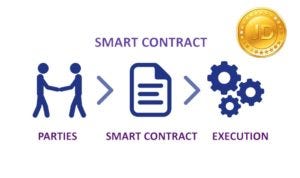
A Smart contract is a computer program or a transaction protocol which automatically executes, control or document legally relevant events or actions according to the terms of a contract/program.


JD Coin Review


This system of automatic execution allows complex transactions to get executed between two parties without requiring an intermediary, any central authority, legal guidance, or an enforcement system. These also helps to solve the issue of mistrust between parties and business partners.
Smart contracts enable variety of advantagesfor a goodrange of industries, reducing unnecessary costs and time expenditure while enhancing transparency. Smart contracts give autonomy, trust, backup with complete safety. The accuracy is not at all compromised with faster speed in completion of task, in fact, it enables savings. The benefits of smart contracts are most apparent in business collaborations wherein it brings simplicity and efficiency to every financial transaction.

jd coin review

Smart contract has use cases that can be found all kinds of situations starting from banking, insurance, energy, e-government, telecommunications, music industry, art, mobility, education, and many more i.e. these may range from simple to complex.
On a blockchain, these streamline the complex process that involves several intermediaries because of a lack of trust among participants in the transaction. Essentially, Smart Contracts use cases can allow for a wide variety of actions.
Let’s examine few real examples of smart contract applications:
  1. The Healthcare Industry: Smart contracts frequently helps with patient privacy and data conservation. This new technology reduces the high transaction costs while improving compliances and protocols. It gives a safe network of access to a secure, transparent record of their health data from patients to health practitioners.
  2. Peer-to-Peer Transactions: Smart contracts can be used for a whole range of peer-to-peer transactions and the possibilities are endless here. These have been used for everything from launching ICO‘s to selling goods on the internet.
  3. Insurance: There are a large number of claim settlement coming in the insurance industry on a daily basis and smart contracts improves and fasten the claim processing in many ways. The insurance company or an individual can easily put an error check and determine payout amounts based on a set of criteria. Critical Information such as driver licenses, driving records, accident reports, and policy details could be immediately processed to facilitate speedy payouts that would benefit both parties.
Insurance companies have to make these complex contracts for its policy users, smart contracts help in making such crucial contracts and further executing them.
  1. Property/real estates: While buying and selling a house or property, there are many people and professional services involved which further adds to the cost to the seller and buyer. They have to pay to the real estate companies, agents, and lawyers to draw out contracts and get the whole procedure done. This process ends up consuming up to five to ten percent of the cost of the property to be paid in commissions. Property ownership related contracts can be recorded with this cost-effective and faster technology of smart contracts. A smart contract is a direct contract between two parties based on trust. There is no need for intermediaries if there is trust.
The expensive services delivered by lawyers and brokers can be avoided as the sellers can handle the transactions completely by themselves.
  1. Finance Trading: The sector of trade was immensely benefitted with the introduction of smart contracts. The labor-intensive chores like heavy calculations and workflow approvals are much automated now, thereby, reducing the work-hours and errors to take place.
Conclusion:
Smart contracts are one of the exciting innovations of Blockchain technology. The application of smart contracts can revolutionize the way we live our lives. The transaction times will be even speedier at lower costs and even make processes much easier and stress-free.